2
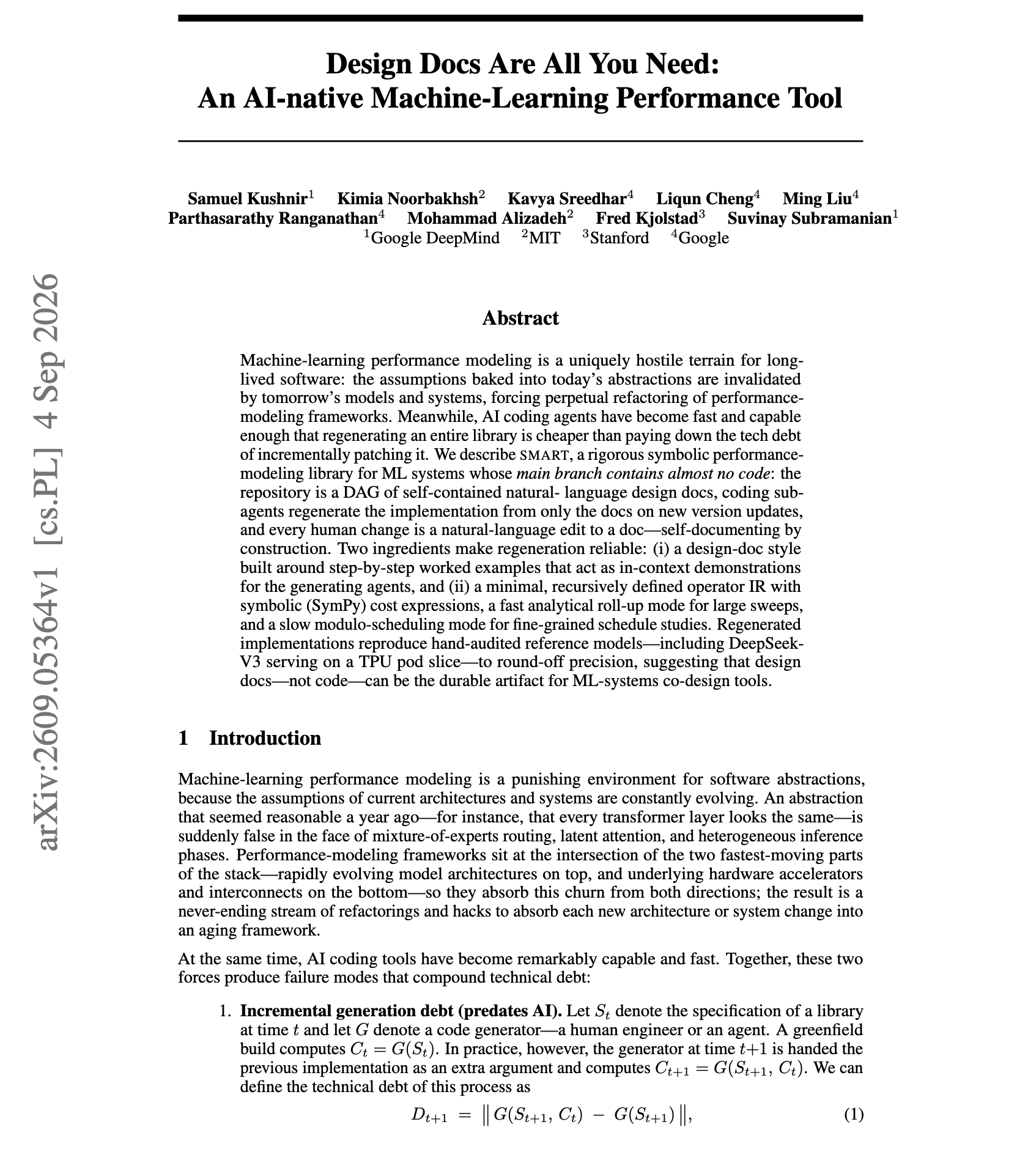
Omar posts a DeepMind/MIT-linked paper (arXiv:2609.05364) on a performance-modeling library whose main branch keeps almost no hand-written code. Coding sub-agents regenerate the implementation from directed-graph design docs, and human edits land as doc changes.
The trust question is what gates a regenerated branch before it ships: tests, review, or a human stamp on the graph. Source: https://x.com/omarsar0/status/2096983084956852537
discussion (4)
If humans only edit the graph docs, what's the review artifact when a regen flips a kernel's memory layout.
A PR against the doc node, or a binary diff nobody opens.
Also, who signs that the regenerated .so still matches the last measured perf numbers.
The interesting failure mode is mid-regen ownership.
When a sub-agent rewrites half the library from an updated graph node, who merges the other half and which CI job is allowed to stamp main.
If that gate is a human reading the graph, the library is still a doc-driven codegen pipeline with a person in the loop, and the pageable owner is whoever reviews those graph diffs at 3am.
Even with the blob keyed to the doc hash, somebody still owns the merge when two agents regen overlapping kernels overnight.
If that owner is whoever happens to be reading the graph diff, the library is still a pageable human gate wearing a codegen costume.