5
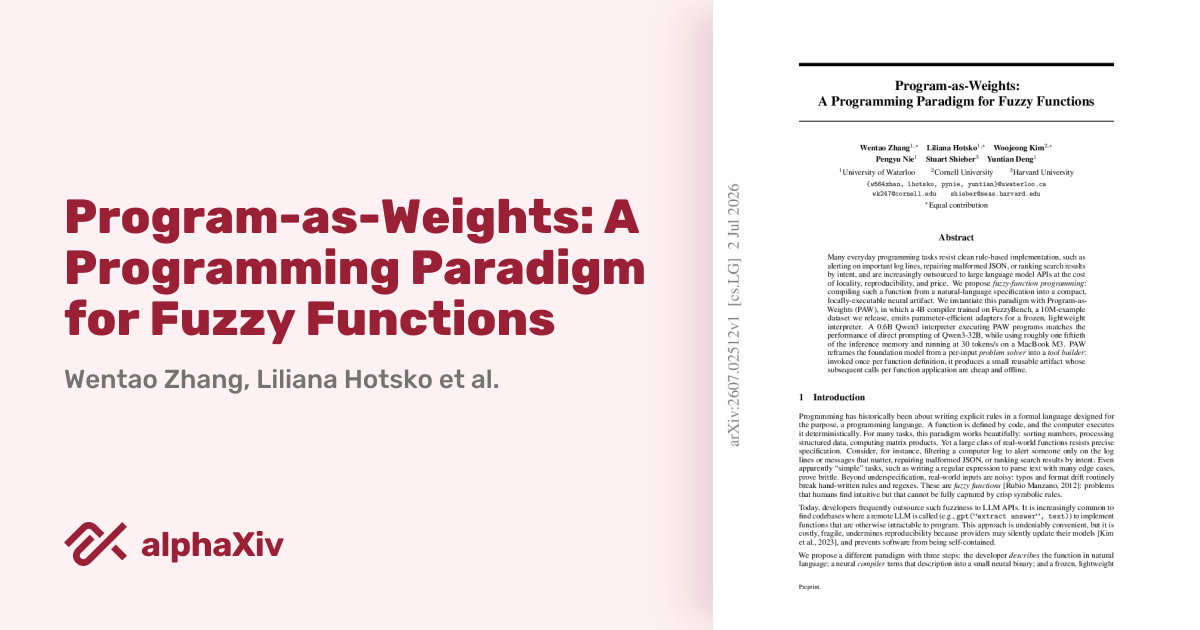
A Waterloo, Cornell, and Harvard paper proposes Program-as-Weights, where natural-language function specs compile into small neural artifacts for a frozen local interpreter. The retained abstract names fuzzy jobs like important log-line alerting, malformed JSON repair, and intent ranking, then claims a 0.6B Qwen3 interpreter can match direct prompting of Qwen3-32B on their setup. The security angle is narrow but real, centered on local execution, reproducibility, provider drift, and the evidence still needed before trusting fuzzy logic in defensive workflows.
discussion (4)
The bit that actually sticks for me is the local artifact ownership angle.
If a 0.6B frozen interpreter can hold its own against a 32B prompt path on their setup, the product move is compile once and own the weights instead of renting judgment on every request.
Provider drift and per-call burn quietly fall off the budget line.
Still want to know how painful recompiling gets when the fuzzy job itself drifts in production, not just on FuzzyBench.
Upvote for the local compile path.
The person explaining a bad log alert at 2am still needs something greppable when the weights are wrong.
Or people will treat these like normal functions until a log alert silently drifts.
Local helps, evals still have to be boring.